Branded web mentions show a stronger correlation with visibility in AI-powered search results than backlinks, based on research analyzing 75,000 brands.
For decades, marketers focused SEO efforts on two primary levers: on-page content and backlink quality. However, as search evolves toward Answer Engine Optimization (AEO), a different signal has emerged.
In our previous article on SEO vs. AEO, we explored how the shift from clicks to citations is redefining visibility in AI-powered search; this analysis builds on that foundation by examining which signals most strongly correlate with the chance of a brand appearing in AI-generated answers.
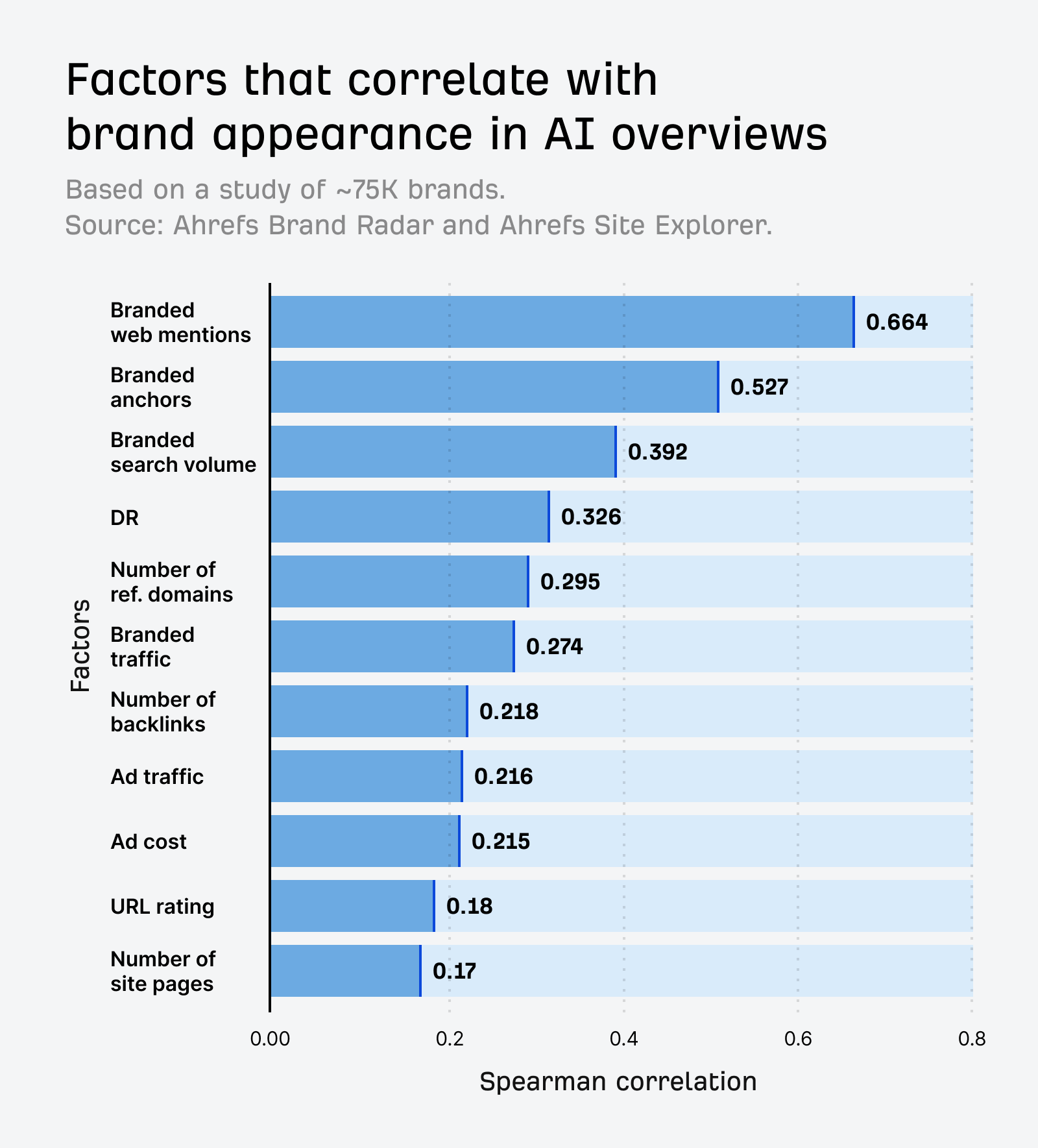
According to an Ahrefs study analyzing 75,000 brands, the single strongest factor correlating with brand presence in AI Overviews is branded web mentions. This data suggests a potential shift in how AI systems surface brands: Visibility in AI search appears to depend less on what a brand publishes on its own site and more on how frequently and consistently it is referenced across the wider web.
The Research Methodology
The study examined both domain and keyword factors to determine what correlates with AI Overview visibility. Domain factors included Domain Rating (DR), referring domains, backlinks, ad traffic, ad cost, and URL rating. Keyword factors included branded web mentions (mentions of the brand name anywhere across the web), branded anchors (brand name used as hyperlinked text), and branded search volume (monthly searches for the brand name). These factors corresponded to each domain’s #1 ranking keyword.
Researchers filtered for domains with DR > 40 and selected each domain’s highest-volume keyword with at least 800 monthly searches. They then analyzed millions of AI Overview responses to identify brand mentions.
About the data: This analysis is based on correlational research and does not establish causation. The study focused on brands with DR > 40 and excluded the brands with zero AI Overview mentions (roughly 26% of total brands).
Branded Web Mentions vs. Backlinks
The study used Spearman correlation coefficient to analyze brand visibility in Google’s AI Overviews. Higher values indicate a stronger statistical relationship.
Branded Web Mentions Drive AI Visibility
-
Branded Web Mentions (0.664): The strongest correlating factor observed in the dataset. This includes any instance of a brand name appearing in text on third-party sites, whether linked or unlinked.
-
Branded Anchors (0.527): Instances where a brand name appears as clickable anchor text.
-
Branded Search Volume (0.392): How often users search for a brand by name.
-
Backlinks (0.218): Traditionally a core SEO signal, but showing a weaker correlation with AI visibility than simple brand mentions.
Large Language Models appear to form associations between brands and topics based on recurring patterns of word co-occurrence across authoritative sources. When a brand is frequently mentioned alongside specific concepts, those associations are more likely to surface in synthesized AI responses.
Visibility Concentration Effect: A Winner-Takes-All Pattern
The data also reveals a pronounced Visibility Concentration Effect.
Brands in the top 25% for web mentions earned an average of 169 AI Overview mentions – more than ten times the visibility of brands in the next quartile (50–75%), which averaged just 14 mentions. Brands in the bottom 50% of web mentions showed minimal visibility in AI Overviews within this dataset, averaging between 0 and 3 mentions.
This pattern may create a reinforcing cycle, where existing visibility increases the likelihood of further inclusion. Brands that are already widely discussed across the web are more likely to be referenced again in AI-generated answers.
Strategic Actions: Building Off-Site Authority
What do these findings tell us? For one, they suggest that AI visibility is shaped less by signals a brand controls directly and more by signals that emerge from the broader web ecosystem. If brand presence in AI-generated answers correlates most strongly with third-party mentions, then improving visibility requires attention beyond traditional on-site optimization.
To improve your AI visibility, your strategy must extend beyond your own domain. Think of traditional SEO as walking into a dinner party and telling everyone how smart you are. That’s on-site content: necessary, but self-asserted.
AI visibility works differently. It’s closer to having several people in the room independently talking about your expertise while you’re not present. Most brand mentions surfaced in AI responses originate from third-party sources such as reviews, forums, blogs, and news articles. AI assistants aggregate these third-party signals rather than relying on a single voice, which helps explain why brands discussed widely across the web are more likely to surface in AI-generated answers.
1. PR and Thought Leadership
Secure placements and mentions in high-authority industry publications. Mentions in AI Overviews correlate strongly with brands appearing on heavily linked, prominent pages.
2. Community Engagement
Actively participate in platforms like Reddit and Quora, which consistently rank among the most cited domains in AI-generated responses.
3. Review Management
Encourage customers and partners to mention your brand name explicitly in reviews, testimonials, and case studies. This builds the third-party validation that AI systems prioritize.
4. Brand Consistency
Maintain consistent naming, positioning, and messaging across channels. This helps AI systems form clearer associations between your brand and its areas of expertise.