
For the past couple of years, the SEO industry has debated how closely SEO and AEO, or traditional search and Answer Engine Optimization are truly tied together. Can a brand bypass traditional Google rankings and still secure visibility within Large Language Models (LLMs)?
According to a February 2026 data analysis, the answer is a resounding no. Following an unconfirmed Google algorithm update in mid-January 2026, researchers tracked 11 major domains that experienced severe organic traffic declines. The resulting data proved a critical architectural reality: if you lose your visibility in Google’s organic search, you will almost certainly suffer a cascading collapse in AI search citations.
SEO and AEO: Google Penalty Hits AI Citations
Here is the breakdown of the data, how different LLMs react to Google penalties, and what it means for your generative search strategy.
The Data: Tracking the January 2026 Update
To isolate the relationship between SEO and AEO, the study focused on sub-categories (mostly content blogs and resource centers) that were hit by the January 2026 algorithm update.
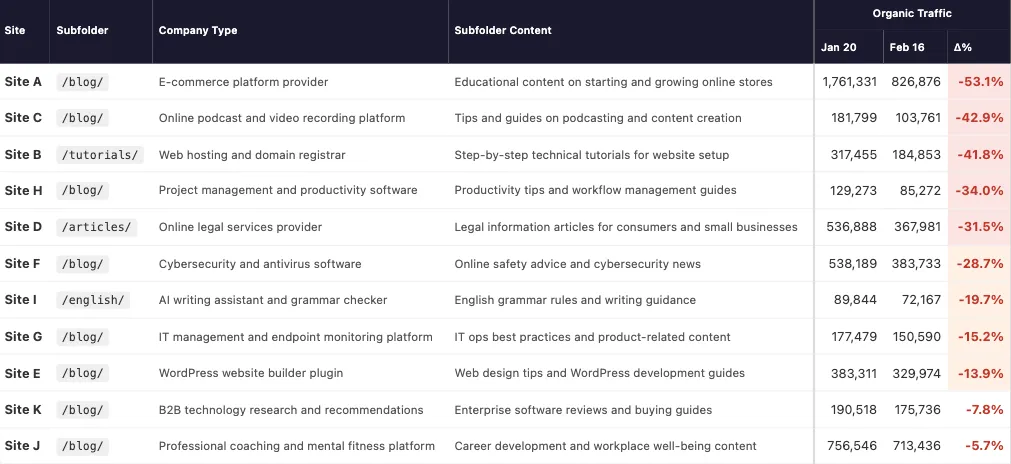
Using the Ahrefs MCP server and Claude Cowork, researchers measured estimated global monthly organic traffic drops between January 20 and February 16, 2026. They then compared those organic declines against the total AI search citations tracked across AI Mode, Gemini, ChatGPT, and Perplexity.
The findings definitively link traditional search health to LLM retrieval pipelines, revealing a broad, highly correlated decline across both surfaces. When Google demotes a site, the AI engines reflect that loss within a matter of weeks.
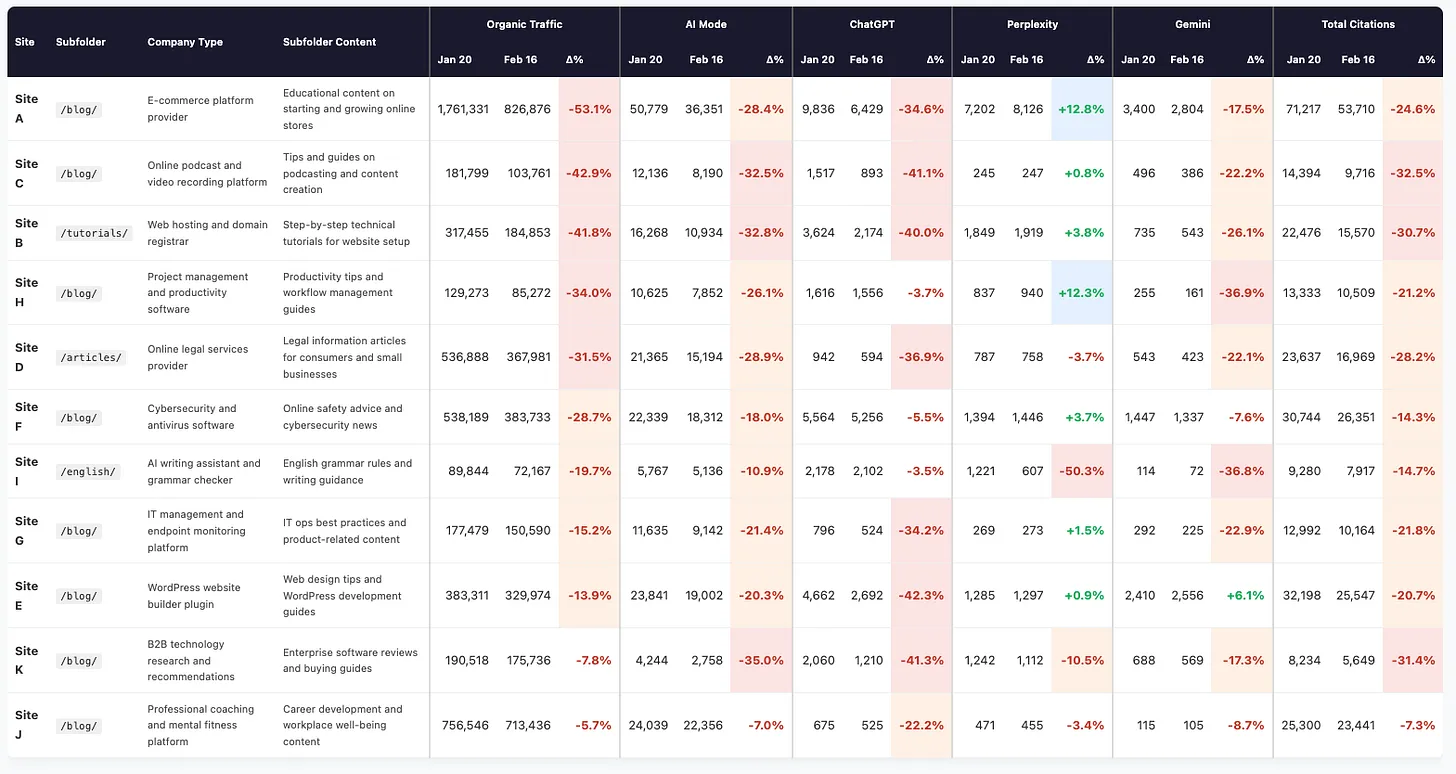
The impact was universal: every single website section analyzed (11 out of 11) experienced a drop in both Google organic traffic and total AI search citations during the roughly four-week study window (from Jan 20 to Feb 16). The average organic traffic drop across these content sections was -26.7%, which triggered a corresponding average AI citation decline of -22.5%.
Platform-Specific Architectural Behaviors
Breaking down the citation drops reveals exactly which AI engines rely on Google’s search index. Across the 11 penalized website sections, the platforms responded as follows:
-
Total AI Citations (-22.5% average): Every single section (11 of 11) lost total citations, proving a 100% correlation between organic penalties and overall AI visibility.
-
ChatGPT (-27.8% average): Reacted most aggressively despite being a third-party tool. Citations dropped by over 34% for seven of the subfolders, peaking at a -42.3% crash (exceeding the site’s organic loss). This suggests heavy reliance on Google’s live index.
-
Google AI Mode (-23.8% average): Closely mirrored the organic drop, indicating tight coupling to live SERP rankings.
-
Google Gemini (Moderate): Experienced declines across 10 of the 11 sites, but the drops were less severe than AI Mode, suggesting reliance on a broader or cached knowledge base.
-
Perplexity (-2.9% average): The sole outlier. Citations dropped for only 4 sites and actually grew for the other 7, confirming it uses a non-Google retrieval pipeline (likely the Brave Search API and its own PerplexityBot crawler).
Strategic Takeaways: The Danger of Gray-Hat AEO
This data establishes a hard rule for digital marketing in 2026: You shouldn’t invest in AEO or GEO tactics if they put your traditional SEO at risk.
Some marketers have advocated for aggressive tactics to manipulate LLMs such as hidden prompt injections, cloaking, or self-promotional listicles. While these might yield a temporary spike in AI citations, they will eventually become algorithmic liabilities.
If these tactics trigger a Google organic penalty down the line, the damage is twofold. Because platforms like ChatGPT rely heavily on Google’s index, losing your organic Google rankings is the fastest way to simultaneously erase your visibility in AI chat interfaces.
While Perplexity offers a Google-independent pipeline, the scale of user adoption dictates where you must focus your resources. According to August 2025 traffic data from Similarweb, ChatGPT received 5.8 billion web visits compared to Perplexity’s 148.2 million. Furthermore, Google’s organic traffic still dwarfs all AI search platforms combined. To win the lion’s share of search visibility, you must maintain pristine standing with Google’s core algorithm.
A strong SEO foundation is no longer just about generating clicks; it is the prerequisite infrastructure for AI visibility.