

In traditional SEO, reputation management was often a game of burial. If a disgruntled former employee or a one-off bad client experience produced a negative result, the goal was simple: push it to page two. If it wasn’t in the top 10 blue links, it effectively didn’t exist.
That era is over.

Managing Your Brand Reputation When LLMs Are Your Primary Researchers
LLMs like ChatGPT, Gemini, and Perplexity don’t just browse the first page of Google; they research. When a prospect asks an LLM about your brand, the model doesn’t just look for your homepage. In order to provide a “balanced” perspective about a brand (with both Pros and Cons), the model digs into the deepest corners of the Internet, including old forums, obscure directory sites, and deep-seated reviews.
In the movie 8 Mile, the protagonist B-Rabbit wins a rap battle by roasting himself first. He leaves his opponent with nothing to use against him.
This is the exact mindset required for AI Visibility optimization. If you aren’t providing the data for the “con” side of the prompt, the AI will go fishing until it finds something that is, regardless of whether it is outdated, inaccurate, or stripped of context.
The Amplification of the Outlier
A recent experiment by Seer Interactive highlighted a chilling reality for B2B brands. Despite a 24-year track record of excellence, LLMs flagged “high account manager turnover” and “owner behavior” as core weaknesses for this agency.
The source of this “truth” was a single negative review from 2018, one that has been systematically duplicated across the web to a handful of directory sites.
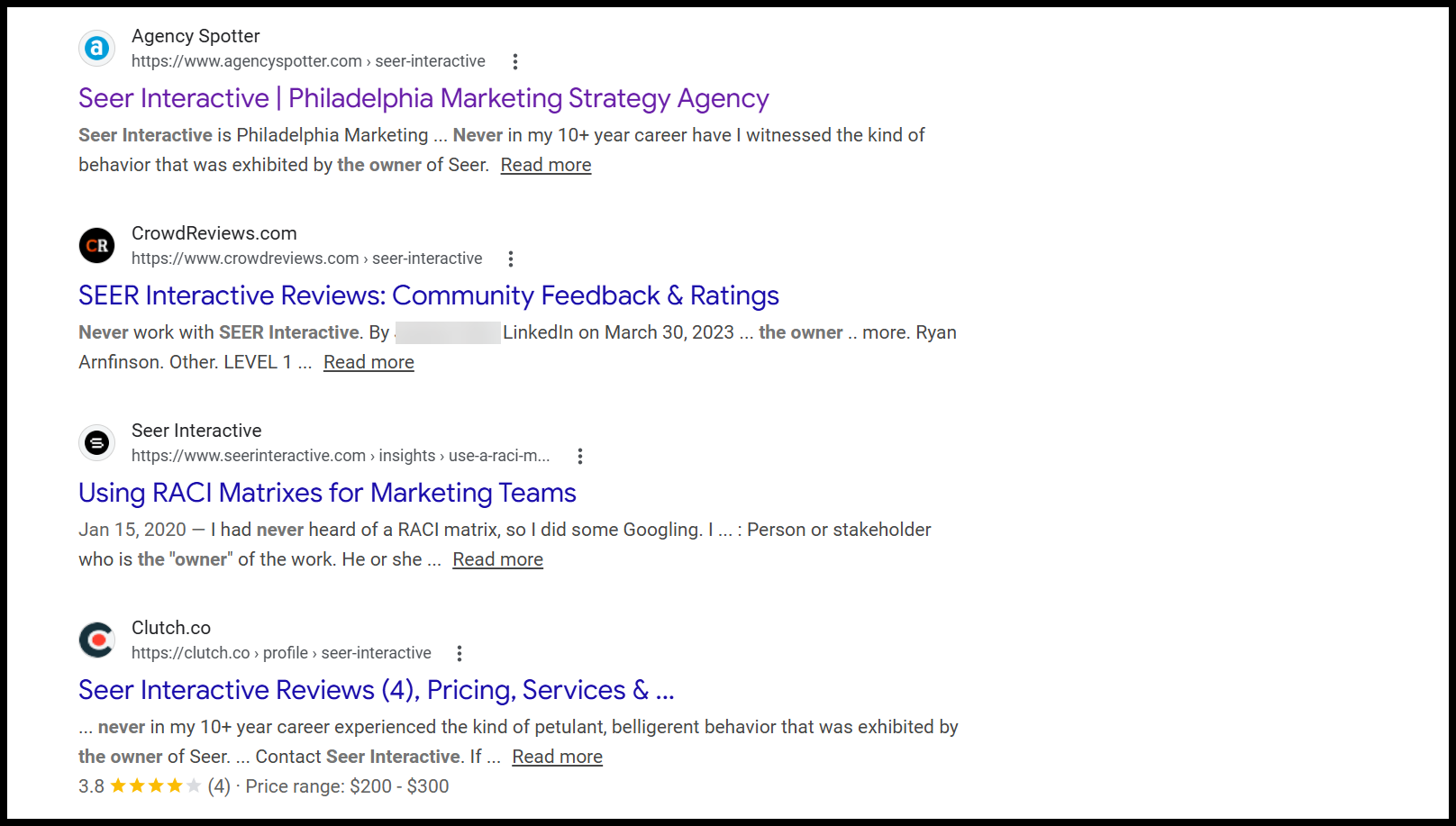
As seen in the search data, the exact same phrasing – “Never in my 10+ year career have I witnessed the kind of behavior…” appears verbatim on Agency Spotter, CrowdReviews, and Clutch. This isn’t a coincidence of human sentiment; it is the result of automated content scrapers and AI-generated review syndication.
In the eyes of a human, one bad review in two decades is a statistical anomaly, and this is obviously a single piece of feedback being echoed. In the eyes of an LLM, seeing that same sentiment on several different sites is corroboration. The AI lacks the context to realize it is reading a circular reference of the same person with a bone to pick. It simply sees a pattern, assumes it is a consensus, and amplifies it into your brand’s primary narrative. For early-stage companies and established agencies alike, this is a blind spot that traditional SEO tools aren’t built to monitor.
A Framework for Reputation Management
To manage your brand narrative in the age of GEO (Generative Engine Optimization), your strategy must shift from “burial” to preemptive disclosure.
1. Audit the Deep Citations
Beside checking your rank for branded keywords, start auditing your citations. Use analytics to identify which specific URLs are being cited when LLMs are asked about your brand’s weaknesses. You may find that a site with zero organic traffic is influencing 40% of your AI-generated brand narrative because the LLM perceives it as a database of record.
2. Address the Consensus Bias
LLMs value consensus over many other signals. If you have one blog post saying “Our turnover is low,” but five different sites saying otherwise, the LLM’s internal logic will weight the 5-to-1 consensus higher. It assumes that if multiple independent sites agree, it must be the objective truth.
To fix this, writing a single post is insufficient; you must break the consensus by updating those sticky third-party profiles with fresh, accurate data.
3. Shift from Content to Infrastructure
A blog post is a temporary fix. As a post ages, its recency signal decays, and the LLM may revert to older, stickier sources that it views as more durable reference points.
-
The Solution: Create a permanent, authoritative Source of Truth page.
-
Keep the URL the same and update the data regularly. This signals to the LLM that this is a primary data source rather than a chronological story that eventually expires.
4. Control the Balanced Narrative
LLMs seek equilibrium. If your website is 100% positive marketing copy, the LLM will look elsewhere to find the “but…” side of the story. To maintain control, incorporate transparency into your own content. “Operyn is currently an early-stage tool focused on [A]; we do not yet support [B].” By providing the “con” yourself, you satisfy the LLM’s search for balance with a narrative you control, rather than an outdated thread from five years ago.
The New Bottom Line For Brand Reputation Management
Your brand narrative is currently being written by bots that don’t understand nuance. They don’t know that a bad review was a misunderstanding. They only know that it exists and that it provides a neutral balance to your marketing copy.
If you aren’t measuring what these models are saying about you, you aren’t managing your brand. You’re just hoping the AI doesn’t go fishing.
Are you curious how LLMs describe your brand to your prospects? Operyn provides visibility into how you are surfaced across the AI landscape. Join the Operyn Insider Program to see what the models are finding when they dig into your brand.

Karamchan
AEO Insights Researcher