

For years, SEO has been one of the most reliable growth channels for ecommerce. Create strong content, rank at the top of Google, drive consistent traffic, and optimize conversions downstream.
That equation is now quietly changing.
Recent data from Ahrefs points to an uncomfortable reality. Even when a page ranks #1, users are clicking far less than before. The issue isn’t weaker execution or poorer content quality — it’s the way Google is reshaping how search works.
What are AI Overviews — and Why do they reduce SEO CTR?
AI Overviews are AI-generated summary boxes that appear at the very top of Google search results for many informational queries. Instead of presenting users with a list of blue links, Google now aggregates answers from multiple websites, synthesizes them into a concise response, and allows users to read, understand, and move on without ever clicking through.
From a user experience standpoint, this is clearly an improvement. From a website traffic standpoint, however, the impact is significant.
According to Ahrefs research, when AI Overviews appear, average click-through rates drop by roughly 34.5%. In simple terms, it’s still possible to rank #1 — but the traffic value of that position is shrinking. Users increasingly get what they need directly from Google’s AI-generated summary.
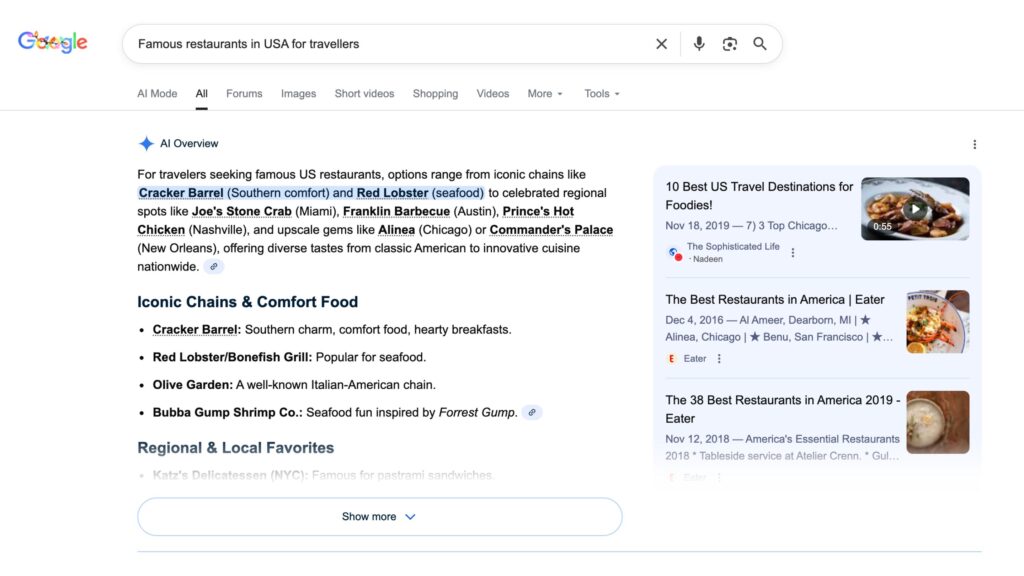
How Google AI Overviews Impact SEO Traffic and Ecommerce Growth
Zooming out, AI Overviews are not just a UI update. They reflect a broader strategic direction from Google. The goal is to keep users on Google for longer, reduce the need to visit external websites, and turn Search into a more closed, self-contained ecosystem.
The modern search journey increasingly looks like this: a user searches, reads the AI Overview, understands the answer, and leaves. There is no click, no session, and no first-party data for publishers or merchants.
Why AI Overviews Are Accelerating SEO Traffic Decline
Today, Google already controls search demand and the advertising marketplace. With AI Overviews, it now also places its own AI-generated answers in the most prominent position on the results page. The consequences of that shift are hard to ignore.
First, organic traffic erosion becomes inevitable. This isn’t about weaker SEO execution — it’s a structural change. There is simply less visible real estate for organic results and a diminished payoff for ranking #1.
As organic delivers fewer clicks, pressure shifts toward paid media. Brands compensate by buying traffic, competition increases, and CPCs rise. For ecommerce teams, this is especially painful. Margins are already thin, and paid media is becoming harder to scale profitably.
Is SEO Still Worth It in an AI-Driven Google Search Era?
AI Overviews are not killing SEO. They are redefining what SEO is for.
SEO is becoming less about pure traffic acquisition and more about brand visibility and authority within AI-driven search experiences. Google is effectively reshaping the rules toward a dual system: pay to gain guaranteed visibility, or earn enough trust and authority to be cited by AI.
Clicks may decline, but presence still matters — especially early in the user journey.
How Ecommerce Teams Should Adapt to Google AI Overviews
The first reality to accept is that escaping Google is not realistic. Google’s reach remains massive, and for many categories, not being visible on Google effectively means not being visible at all. The more practical approach is to continue investing in Google while actively managing dependency risk.
At the same time, content strategies need to evolve. Optimizing for AI Overviews is no longer optional. Content that performs well in this environment tends to answer questions clearly and directly, use strong structure, and rely on neutral, factual language that is easy for AI systems to summarize. The goal is no longer only to rank at the top, but also to be selected, summarized, or cited by AI. Even if clicks decline, this still delivers brand visibility, perceived expertise, and presence early in the decision-making process.
Ecommerce teams should also plan for sustained advertising cost inflation. This means revisiting paid media budgets, measuring performance based on profit rather than surface-level ROAS, and investing in conversion rate optimization so every click carries more value.
Finally, channel diversification is no longer optional. Email, CRM, social, community, marketplaces, affiliates, and alternative ad platforms all deserve deeper investment. The objective isn’t to replace Google entirely, but to reduce platform risk and retain ownership of customer relationships.
Summary
AI Overviews are pulling clicks away from websites, weakening the economic value of organic rankings, and increasing reliance on Google Ads. For marketers and ecommerce merchants, this shift forces a rethink of SEO, paid media, and channel strategy in an AI-first search era.

Mina
Content Marketer