

For years, SEO has been one of the most reliable growth channels for ecommerce.
Create content, rank on Google, drive traffic, convert users.
Then AI Search arrived.
With the rise of ChatGPT, AI Overviews, Perplexity and conversational search interfaces, a familiar narrative has returned: “SEO is dead.” Users ask AI instead of Google. Answers appear instantly. Clicks decline. Traditional rankings seem less meaningful.
But this conclusion is based on a misunderstanding of both how users search and what SEO is actually meant to do.
SEO is not dying. It is evolving — and for eCommerce brands, that evolution matters more than ever.
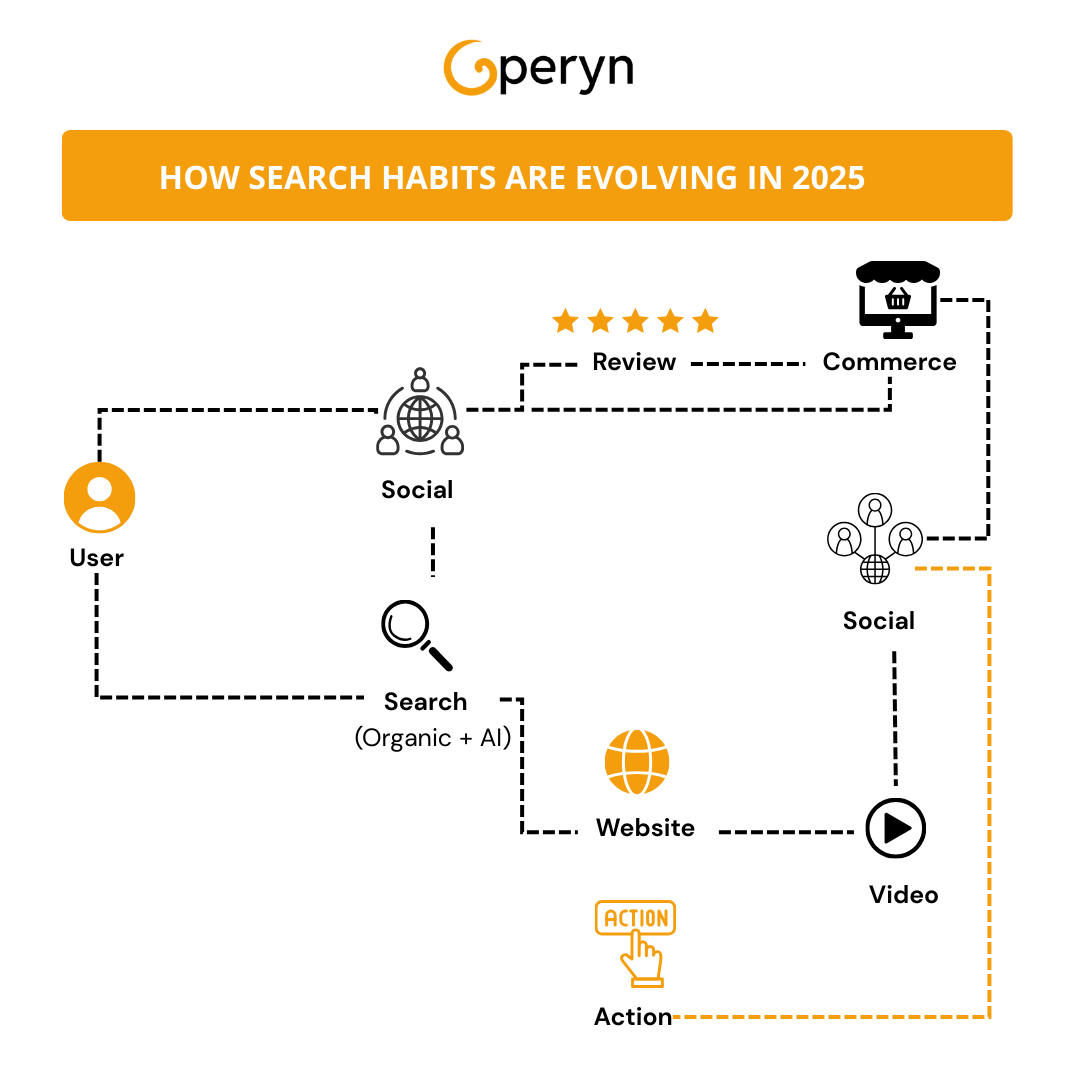
How people search in 2025 (Source: backlinko)
AI Search Is Changing How People Ask — Not Why They Ask
AI-powered search experiences are undeniably popular. They feel faster, more conversational and more human. Users turn to large language models when they need explanations, advice, comparisons or personalized guidance. These systems excel at synthesizing context and presenting information in a way that resembles a knowledgeable consultant.
However, this does not replace traditional search behavior. When users need fact-based answers, pricing details, official documentation, product pages, reviews or comparisons across vendors, they still rely on search engines. ECommerce decision-making often requires verification, specificity and trust — things that still live on websites.
What has changed is not the need for search, but the shape of it. AI Search handles exploratory and advisory queries. Traditional search remains dominant for transactional and evaluative intent. SEO sits at the intersection of both.
The Real Shift: From Ranking Pages to Answering Questions
Classic SEO was often treated as a ranking game. Success was measured by keyword positions and organic traffic volume. In the AI Search era, that mindset is no longer sufficient.
Modern search systems — including AI Overviews — are not asking which page uses the right keywords. They are asking which source explains a topic most clearly, most accurately and with the most context. Pages are no longer competing only for clicks. They are competing to become the source of truth.
For eCommerce brands, this means SEO is moving closer to product education, buying guidance and decision support. Content that helps users understand when to use a product, who it is for, what trade-offs exist and how it compares to alternatives is far more valuable than surface-level optimization.
SEO Is Becoming Intent- and Context-Driven
AI systems do not evaluate content in isolation. They evaluate whether a piece of content demonstrates an understanding of user intent across different stages of the journey.
In eCommerce, this means addressing not just “what is this product,” but also “is it right for my business,” “how does it compare,” and “what happens after I buy.” Pages that only define a product category without context are increasingly invisible. Pages that guide decisions are increasingly cited.
This is not a new concept. It is the logical continuation of intent-based SEO — accelerated by AI.
Authority, Not Keywords, Is the New SEO Foundation
One of the most important changes AI Search introduces is its focus on entities rather than pages. Search engines and AI systems aim to understand brands, products and expertise at a broader level.
A single article about a POS system carries limited weight. A structured body of content covering use cases, pricing logic, integrations, operational challenges and industry-specific scenarios signals real authority. Over time, this builds trust not just with users, but with AI systems that must decide which sources to rely on.
For eCommerce brands, SEO is no longer about isolated optimizations. It is about building topical authority that reflects real-world expertise.
E-E-A-T Is No Longer Optional
Experience, expertise, authoritativeness and trustworthiness were once treated as guidelines. In AI Search, they function more like filters.
AI systems actively avoid vague, generic or derivative content. They favor firsthand experience, clear points of view and content that demonstrates real understanding of ecommerce operations. This is particularly relevant for merchants and marketers, where practical insight matters more than abstract theory.
Content written from experience — informed by actual eCommerce workflows, challenges and data — has a structural advantage. Not because it is optimized for AI, but because it is genuinely useful.
SEO Is Expanding Beyond Google
Another misconception behind the “SEO is dead” narrative is the assumption that SEO exists only for Google’s blue links. Today, visibility happens across multiple surfaces: traditional SERPs, AI Overviews, conversational assistants and emerging AI agents.
SEO now plays a role in whether a brand is mentioned, cited or recommended — even when no click occurs. This shifts the goal from traffic alone to search visibility and influence. For eCommerce, this means shaping perception earlier in the decision-making process, long before a purchase happens.
What This Means for eCommerce Marketers and Merchants
AI has not replaced SEO. It has raised the bar.
Content that exists solely to rank will struggle. Content that exists to educate, guide and support decisions will continue to surface — across both traditional and AI-powered search experiences.
For eCommerce brands, the opportunity is clear. Those who invest in depth, clarity and authority will not only survive the AI Search transition, but benefit from it. Those who rely on outdated tactics will interpret reduced clicks as the death of SEO, when it is actually a signal to evolve.
Final Thought
SEO is not dying because AI answers questions faster.
SEO fails only when it stops helping users make better decisions.
In an AI-driven search landscape, the brands that win are the ones that understand this distinction.

Mina
Content Marketer