Google Just Opened a Window Into AI Search Visibility
Google’s new Search Console AI reports give site owners early visibility into AI Overview, AI Mode, and AI Discover impressions, but they still leave major gaps around clicks, cross-platform brand representation, and broader AI visibility measurement.

Ly Phan
AI Visibility Researcher and Editor
Update on
Visibility Monitoring

On June 3, 2026, Google announced something SEOs have been asking for since AI Overviews launched: a dedicated performance report for generative AI features inside Search Console.
The new reports give site owners a separate view of how often their URLs appear inside AI Overviews, AI Mode, and AI-powered Discover features, broken down by page, country, device, and date.
This is a significant shift. Before today, those impressions were buried inside the overall Performance report with no way to separate them from traditional blue-link results. If your content was being cited inside an AI Overview, you had no official way to know. Now you do. Sort of.
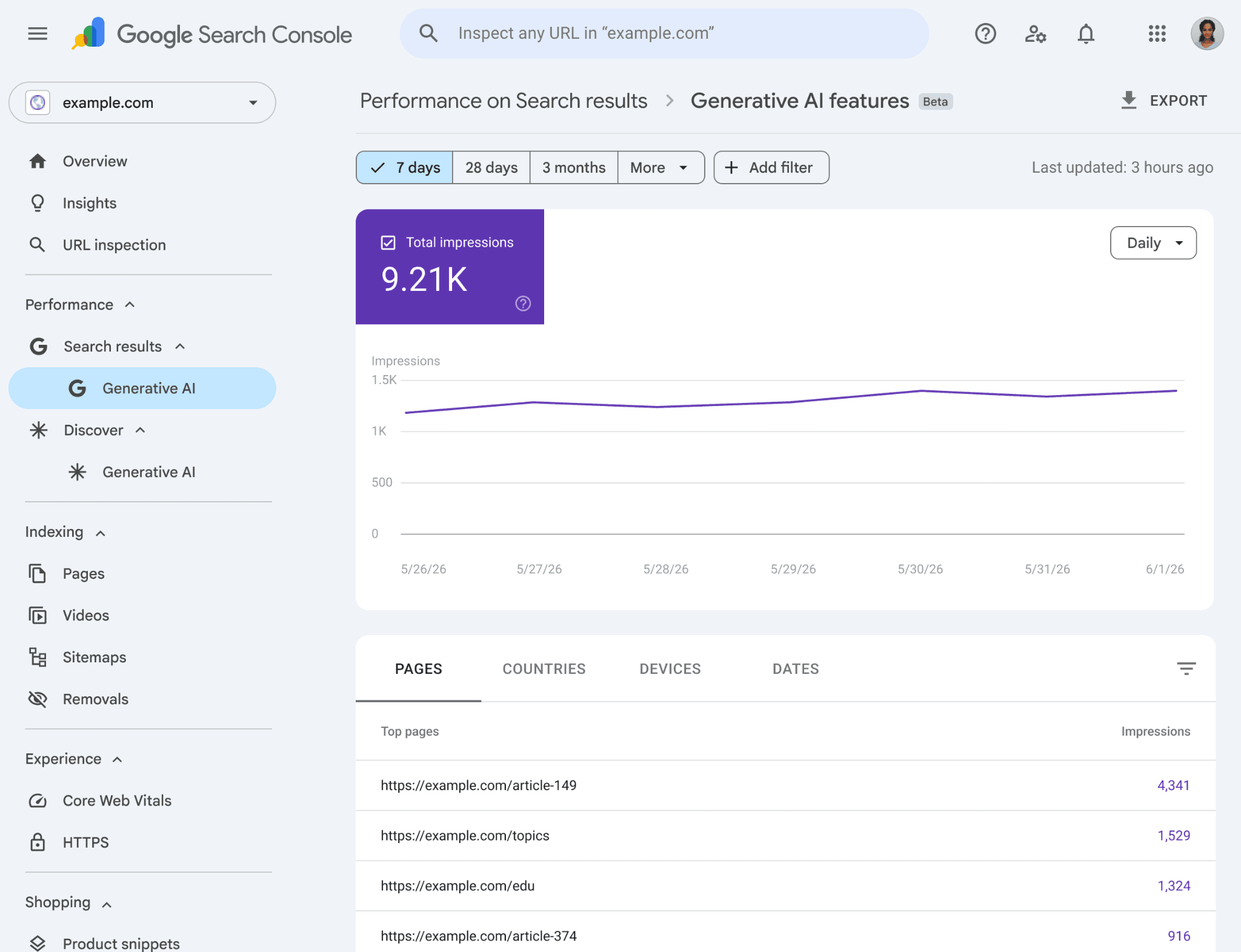
What Google is actually giving you
The new reports include impressions, page-level breakdowns, country data, device data (available for Search results), and date-range filtering with hourly, daily, weekly, and monthly granularity.
Click data isn't on that list. Google didn't say whether it's coming, only that they're "continuing to work with website owners to understand what insights and data would be most helpful to inform their strategies, such as adding additional metrics over time."
That's a diplomatic way of saying: the most important number isn't there yet.
The opt-out toggle is the bigger story
Separately, Search Engine Land reported that Google is also testing a site-level toggle that lets site owners opt out of having their content appear in AI Overviews and AI Mode. According to that reporting, sites that opt out will not receive traffic or impressions from Google's generative AI features, and the control will not be used as a ranking signal for search results outside those features.
The opt-out is reportedly limited to a subset of UK website owners, tied to regulatory pressure from British competition authorities. It is expected to expand from there.
If the toggle holds up, it's a concession that publishers have a legitimate stake in controlling how AI systems use their content. That matters as a precedent, independent of whether any individual site actually opts out.
The measurement gap that remains
What Google launched solves one narrow problem: you can now see if Google's AI surfaces are picking up your content. That's genuinely useful.
But it doesn't answer the broader question most brands are sitting with right now: how is my brand being described across AI platforms? Not just Google, but ChatGPT, Perplexity, Claude, Copilot, and every other AI answer engine that millions of users are querying every day.
Search Console only covers Google's own surfaces. It can't tell you if another AI model is hallucinating your pricing, misattributing a product feature, or describing your company using outdated information. It can't tell you your share of voice when someone asks an AI to recommend tools in your category.
Google's report is a starting point. But starting points reveal how much further there is to go.
What to do now
If you're a site owner, watch for access to the new Search Console reports rolling out. Google says the initial release is going to a subset of websites first.
More importantly, start treating AI visibility the same way you treat search visibility: as something that needs to be measured, monitored, and actively managed. The data Google released confirms that AI surfaces are now a distinct traffic channel with distinct performance dynamics. They deserve their own measurement stack.
That's true whether you're optimizing for Google's AI features or tracking how a dozen other AI platforms are representing your brand to potential customers.
Share on social media