See Every Source AI Assistants Read Before They Answer, Not Just The Ones They Cite
Feature Update: Operyn Retrieved Source Visibility

Ly Phan
AI Visibility Researcher and Editor
Update on
Product Mechanics

Every AI visibility tool on the market works from the same raw material: the final answer. They scrape what the assistant said, count the brand mentions, log the citations, and call it measurement. The problem is that the final answer is the last step of a long pipeline, and citations are the only part of that pipeline anyone has been able to see.
When someone asks an AI assistant a question, the model breaks the question into a set of narrower search queries (the fan-out), runs those searches, retrieves a batch of sources for each one, reads them, and then synthesizes an answer. Out of everything it read, it cites a handful of pages, sometimes two or three. The rest of the retrieval set, often dozens of pages, vanishes. The user never sees those sources, and until now, neither did the brands competing to appear in the answer.
Operyn now captures that full retrieval set. For every fan-out query behind an AI response, you can see which sources the model pulled before it wrote a single word, whether they ended up cited or not.

Why uncited sources matter more than you'd think
While citation counting tells you who won, retrieval data tells you why.
When your page gets retrieved but not cited, the model found you, read you, and chose someone else's content for the answer. That is a synthesis problem. Your page matched the query but lost on substance: maybe it lacked the specific number the model needed, maybe a competitor's page answered the question more directly, maybe your content buried the relevant claim under marketing copy.
When your page never enters the retrieval set at all, you have a different problem entirely. The model's searches aren't surfacing you. No amount of content polish fixes that, because the model never opens the page. You need coverage: pages that match the actual fan-out queries your category generates.
Without retrieval data, these two failure modes look identical. You're absent from the answer, and you're left guessing which lever to pull. With it, the diagnosis takes one look.
What the retrieval sets reveal in practice
The composition of retrieval sets surprised us during testing. For a single product question, a model might pull a manufacturer's product page, an Amazon bestseller list, two YouTube reviews, a Reddit-style forum thread, a TikTok video, and a niche blog's buying guide, all for one fan-out query. Most of those never get cited. All of them shaped the answer.
This explains a pattern brands keep running into: a competitor dominates AI answers without holding obvious citation share. Their content shows up in retrieval across many fan-out queries, influencing synthesis even when the model credits a different source. You could not see that influence by reading final answers, because it only shows up at the retrieval layer.
It also reframes where to publish. If forum threads and video transcripts keep appearing in your category's retrieval sets, those channels are feeding AI answers whether or not they earn citations. Your content plan should account for that.
Where to find it
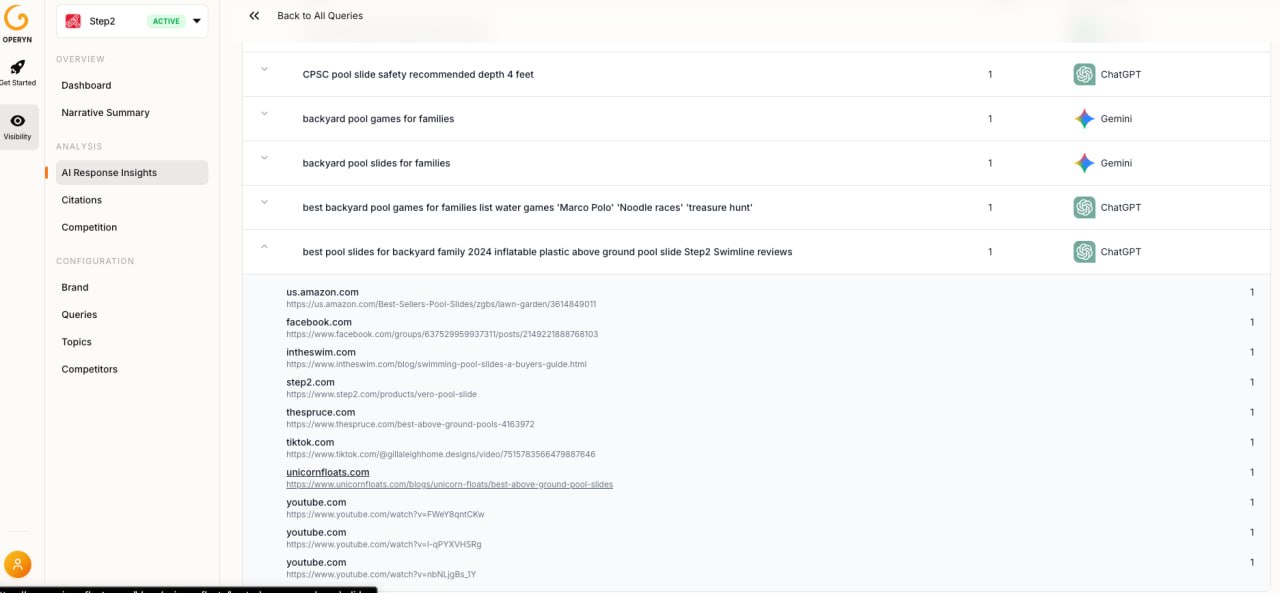
Retrieved sources live inside the fan-out view. Open any monitored query, switch to the Fan-out tab, and expand an individual fan-out query to see the sources the model pulled for it, with the pages it retrieved from each domain. Cited and uncited sources sit side by side, so you can trace exactly which retrievals made it into the answer and which got read and dropped.
Fan-out visibility was already the part of Operyn most competitors can't replicate. Retrieval capture extends it one layer deeper: from seeing the questions the model asks itself to seeing the material it reads before it answers. If your job is to influence what AI assistants say about your category, this is the earliest point in the pipeline where you can measure whether your content is even in the room.
Share on social media