The Google Rank-Citation Gap: Why 40% of ChatGPT Answers Ignore the Top 10
ChatGPT can diverge sharply from Google rankings by skipping top SERP results in favor of fresher, cleaner, better-structured, lower-ranking pages, making AI citation visibility a separate optimization layer from traditional SEO.

Karamchan
AEO Insights Researcher
Update on
Visibility Research

The conventional wisdom that "ranking #1 on Google means you’re #1 in AI answers" is being dismantled. A recent study by FlipAEO analyzed high-intent queries to determine the correlation between traditional Search Engine Results Pages (SERP) and AI citations. The study revealed a significant divergence: 40% of the time, ChatGPT ignores the Google Top 10 entirely.
The "Page 2" Anomaly: The Google Rank-Citation Gap
The findings prove that you do not need a decade of backlink history or massive domain authority to win the citation. This offers a critical roadmap for early-stage startups focused on AI visibility and AEO (Answer Engine Optimization).
Methodology and Key Finding
The study utilized a manual comparative audit to bypass the limitations of automated rank-tracking. Researchers curated a dataset of high-intent B2B queries to trigger ChatGPT’s web-search mode. For each query, they pulled the Top 50 Google organic results and mapped every URL cited in the ChatGPT response back to its SERP position.
To identify the drivers of citation, each page was audited for Token Density (info-to-filler ratio) and Layout Noise (ad and pop-up interference). Finally, the author tracked citation decay over time to measure the freshness floor against stable search rankings.
The most striking discovery from the study is that in 40% of the cases analyzed, ChatGPT completely ignored the Google Top 10. Instead of citing the market leaders, the model bypassed high-authority domains to extract information from positions 11 through 50.
This anomaly indicates that traditional Domain Authority is no longer a defensive moat. ChatGPT appears to be digging deeper than the average human user to find the most structurally sound answer, rather than the most heavily linked one.
Rank-Citation Gap Explained
The research identified 3 specific technical filters that cause ChatGPT to abandon a top-ranked Google result in favor of a lower-ranked competitor.
1. The Structure Filter
The AI frequently skipped #1 ranked sites that were "messy" with heavy ad placements, interstitial pop-ups, buried answers, or fragmented text blocks. The winners were often smaller sites on Page 2 or 3 that provided data in clear markdown tables, lists, or concise definitions. This suggests that ChatGPT prioritizes the ease of information extraction over legacy brand signals. If your data is easier to parse and summarize, the model will spend the compute to find you, even if you lack a massive backlink profile.
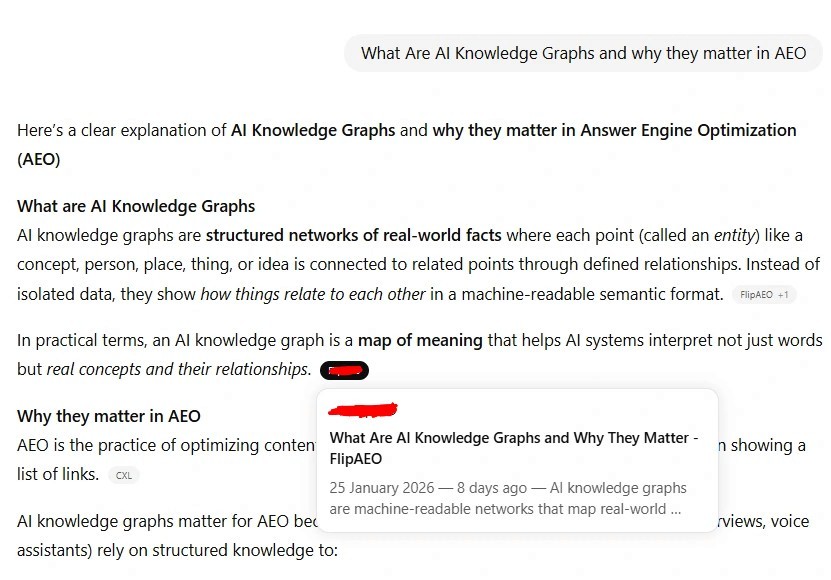
A new site with DA = 0 winning the #1 citation spot for it provided a direct definition that the AI could easily parse.
2. The Freshness Floor
While you can "coast" on Google rankings for months without updating content due to historical authority, the study found that ChatGPT treats content more like a news feed. When content updates ceased on test sites, ChatGPT referral probability dropped almost immediately, even in instances where Google traffic remained stable. This indicates that silence is a direct path to invisibility. To remain "citable," a brand must maintain a high content velocity.
3. The Reddit Paradox
Google currently prioritizes Reddit and user-generated forums in the SERPs. However, the study found that in nearly every case where Reddit ranked #1, ChatGPT skipped it. The model showed a clear preference for structured, expert-led content when generating the synthesized response, even if it lists forum discussions in the "sources" sidebar.
What This Means for SEO Practitioners
This study validates why AI Visibility analytics must be treated as a separate discipline from SEO. If you are only measuring your Google rank, you are blind to nearly half of the retrieval landscape. Marketing at this stage is a diagnostic system intended to identify where a brand is being omitted despite its perceived authority.
The objective for early adopters is to shift focus from Keyword Density toward Structural Clarity. Practitioners should audit their brand's mention and citation metrics to identify the gap between their search rank and their AI visibility. By monitoring the content heartbeat and ensuring data is LLM-ready rather than just browser-ready, brands can move from being omitted to being cited as a definitive source.
Operyn is currently helping the first wave of SEO practitioners navigate this divergence and protect their digital footprint. Our Insider Program provides early access to the diagnostic tools needed to measure and close the gap between your Google rank and your AI visibility.
Share on social media