Scraping vs. API: How to Track Brand Visibility in AI Search
As consumers turn to AI for answers, monitoring your brand's presence is essential. But common methods to track AI responses like UI scraping are risky and unreliable. Discover the compliant, scalable way to track your brand's visibility across AI platforms.

Ly Phan
AI Visibility Researcher and Editor
Update on
Product Mechanics

The AI search visibility market has an honesty problem.
A growing number of tools promise to show you exactly how your brand appears in AI-generated answers - across ChatGPT, Claude, Gemini, Perplexity, and others. The pitch is straightforward: we monitor what AI says about you so you can optimize for it. But behind that pitch, there's a fundamental technical question most of these tools aren't being upfront about: where does the data actually come from, and does it represent what your customers see?
The answer, for most tools on the market, is no. And the reason goes deeper than the usual "scraping vs. API" debate suggests.
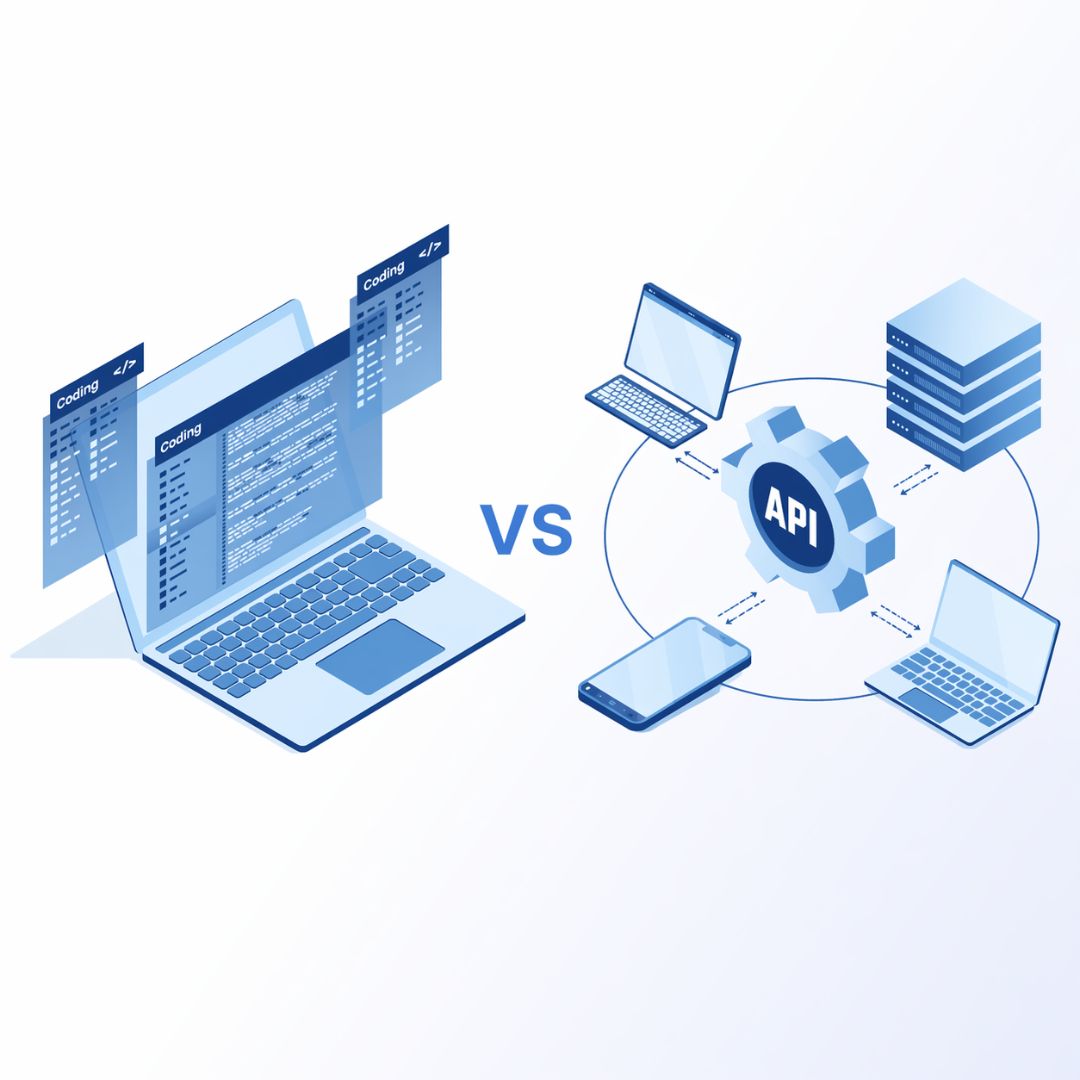
Scraping vs. API: The Strategic Choice for AI Visibility
Scraping vs. API: Two Methods, Fundamentally Different Approaches
Before going further, it helps to understand what these two approaches actually are, because the difference isn't just technical plumbing. It actually determines what data you get, how reliable it is, and whether the platform you're monitoring considers your access legitimate.
UI scraping (also called crawling) works by pretending to be a human user. An automated bot opens a browser, navigates to ChatGPT's web interface, types in a prompt, waits for the response to render, and extracts the text from the page. It's the digital equivalent of hiring someone to sit at a computer, ask questions, and copy-paste the answers into a spreadsheet. The AI platform doesn't necessarily approve of this happening, especially if any commercial use is involved. The bot has to manage login sessions, dodge CAPTCHA challenges, and adapt every time the interface changes.
API-based monitoring works through the front door. AI platforms like OpenAI, Google, and Anthropic publish official APIs, which offer structured, documented interfaces designed for programmatic access. Instead of simulating a browser session, you send a request directly to the AI model and receive a structured response back. The platform knows you're there, the access is sanctioned under their Terms of Service, and the response comes with metadata such as which model answered, whether a web search was triggered, or which sources were cited.
Think of it this way: scraping is recording a TV show by pointing a camera at the screen. API access is getting the original broadcast file from the studio. Both give you the content, but only one gives you the quality, the metadata, and the permission.
The Debate Everyone's Having (And Why It's The Wrong One)
Now that you know the difference, here's where the industry debate stands: the scraping camp argues they capture "the real user experience." The API camp argues they're more reliable, scalable, and compliant.
Both sides are partly right. But both are also missing the bigger picture, because neither is asking the question that actually matters to your brand.
That question isn't "scraping or API?" It's this: When an AI platform answers a question about your industry, your category, or your product, is the data you're collecting an accurate representation of what the majority of real users actually receive?
The honest answer is that neither method, if used naively, gets this right. And the research bears that out.
What The Data Shows
Graphite ran one of the more rigorous studies on this question and tested scraping (logged-out), scraping (logged-in), and API-based methods against the same prompt.
First, the web search trigger rates diverge dramatically depending on method. In logged-out ChatGPT sessions, about 10% of prompts trigger a web search. In logged-in sessions, that jumps to around 50%. And when using the API with OpenAI's built-in web search tool enabled, the rate is 99.8%.
These three numbers tell an important story. Logged-out scraping drastically under-searches compared to what real users experience. But raw API with search enabled dramatically over-searches. Neither matches the behavior of a typical logged-in user, who falls somewhere in the middle.
Second, Graphite found that within each method, results are reasonably consistent, with responses clustering around similar distributions with agreement scores of 0.70–0.76. But across methods, agreement drops to 0.48. API and scraping aren't returning slightly different versions of the same answer. They're measuring meaningfully different slices of AI behavior.
Graphite's recommendation was nuanced: APIs are the practical choice for scale, but they measure a different thing than what users see in the chat interface. The immediate suggestion was to supplement API monitoring with manual logged-in collection.
This is an honest finding, and we think more of the industry should engage with it seriously. It means the question isn't which method is "right." It's which method gives you a workable signal at the scale you need.
Where Scraping Hits The Ceiling
To be fair: scraping isn't worthless. For small-scale, exploratory checks like "let me see what ChatGPT says about our brand right now," a scraped response gives you a real, rendered output. It's a snapshot, and snapshots have value. The problems start when you try to scale that into a monitoring program.
DataForSEO's live mode scraper reports turnaround times around 90 seconds per query at best. That's their optimized case. Multiply by thousands of queries across multiple AI platforms, multiple geographies, and multiple query variations, and you're looking at days of latency for a single monitoring sweep. API calls return in seconds.
There's also the durability question. Every scraping operation depends on the AI platform's UI staying unchanged. A layout update, a new CAPTCHA system, a change in authentication flow — any of these can silently break your data pipeline. The scrapers' moat is purely operational: managing the infrastructure to keep sessions alive and parsers current. That moat erodes every time the platform ships an update, which for major AI platforms is weekly or more.
And the compliance exposure is straightforward. Most AI platforms explicitly prohibit automated scraping in their Terms of Service. If your monitoring tool relies on access the platform hasn't sanctioned, your tool's existence depends on the platform not noticing or not caring enough to enforce. That's a bet, not a strategy.
The Problem With API Search Tool
Here's where most of the "API is better" arguments get sloppy. The standard claim goes something like this: "Every major AI platform now offers API endpoints with integrated web search. Turn it on and you get the same grounded, search-backed answers users see in the chat UI."
This isn't accurate. API-with-search-enabled and ChatGPT-with-browsing are different systems. They use different search backends. They have different decision logic for when to search. They apply different system prompts. They rank and select results differently. And as Graphite's data shows, the API's built-in search tool fires on nearly every query (99.8%), while the chat UI searches about half the time. These are clearly not the same routing logic.
A tool that simply enables the API's built-in web search and reports the results is compliant and scalable, which is better than scraping. But it's producing an over-searched version of reality. Every answer comes back grounded in web results, even for queries where a real user's ChatGPT would have answered from training data alone. That distortion matters if you're trying to understand how your brand actually surfaces in typical AI interactions.
Most visibility tools measure what the AI said. The harder, more important question is how it arrived there, and whether that process resembles what happens when a real customer asks the same question.
What We Built, And Why
At Operyn, we chose to build on API infrastructure, but not in the way most people mean when they say "API-based monitoring."
We don't use the AI platform's built-in web search tool. Instead, we provide the model with a custom search tool that we built and control. The model decides when to search based on the prompt and our instructions. But when it searches, it searches through our tool, not the platform's built-in one.
This matters for three reasons.
Observability. When the AI model processes a prompt about your brand, it often fans out into multiple search queries internally, researching competitors, checking recent news, or looking for product comparisons. With the built-in search tool, that fan-out happens inside a black box. You get the final answer and maybe some citations, but you never see the intermediate queries that shaped the response. Because Operyn controls our search tool, we capture the full chain: every query the model generated, every result it considered, and how those results influenced the final answer. We measure how the AI arrived at its response, because that's what tells you whether a brand mention is stable or accidental.
Tunability. The built-in search tool is a one-size-fits-all system. You can't configure it for a specific market, language, or geographic context. Our search tool can be tuned per client, so a brand monitoring its visibility in Australia, for example, gets search behavior relevant to that specific market, not a generic global default.
Trigger control. The model still decides when to search; we don't force it on every query. But we shape that decision through our instructions, which we can adjust. This is the difference between a fixed 99.8% trigger rate and a system where search behavior is guided by context. We can instruct the model to search when information may be outdated, when competitive context matters, or when the query type warrants fresh data. We don't settle with either always searching or leaving it entirely to the platform's default logic.
None of these are performance claims that require a benchmark. They're structural capabilities — observable in our product, demonstrable to any client, and fundamentally different from both scraping and raw API-with-search approaches.
What Survives
The AI search visibility space is young and crowded with tools making aggressive claims. Some are sophisticated scraping operations. Some are, frankly, a system prompt and a web search call wrapped in a dashboard. Most are selling the same underlying capability at different price points with different marketing narratives.
Here's the pattern that predicts which approaches last:
The tools built on defensible architectural choices — sanctioned API access, stable versioned endpoints, predictable cost structures, and clean data pipelines — will still be running when the current wave of scraping-based tools has cycled through its third or fourth infrastructure rebuild. The tools built on operational hacks will keep shipping fixes until the platform changes make the fix more expensive than the tool is worth. And the tools that go beyond raw API calls to build real instrumentation around how AI generates answers will have data that the flag-flippers can't match.
AI platforms are not going to make scraping easier. They're investing in authentication complexity, bot detection, and personalized experiences that are inherently hostile to generic session scraping. Every platform update widens the gap between what a scraper sees and what a real user sees.
Meanwhile, those same platforms are investing heavily in their API ecosystems, by expanding capabilities, adding web search integration, improving documentation, building developer relations programs. The direction is unambiguous.
The brands that build their AI visibility strategy on a foundation the platforms are actively strengthening rather than actively undermining will have a meaningful advantage. Not because any current monitoring approach perfectly replicates the user experience today. None does. But because the right architecture gives you a foundation that gets closer over time, instead of one that drifts further away.
The hack always expires. The integration doesn't.
Share on social media